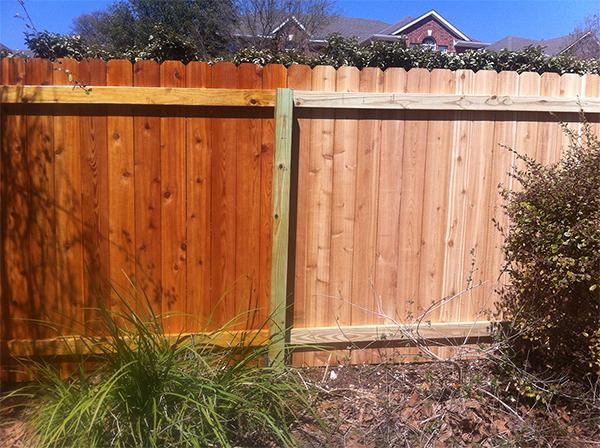
Cedar stains better than pressure-treated lumber in nearly every case. The difference shows up in year two: cedar holds oil-based stain deeper into the grain, while PT wood's chemical treatment slows penetration and shortens the life of the finish.
Cedar absorbs penetrating oil-based stain better than pressure-treated pine in nearly every case. The difference is most visible at the two-year mark: cedar still shows good colour and sheds water reliably, while PT wood at the same age often looks patchy and has started to grey at the edges. That gap comes down to chemistry.
Why pressure-treated wood is harder to stain
Pressure-treated lumber is saturated with chemical preservatives — most commonly copper azole or copper boron azole compounds — that protect against rot and insects. Those same preservatives slow the absorption of oil-based stains. The wood is essentially pre-occupied with another treatment that competes with what you're trying to apply.
New PT lumber is also often wetter than it looks. The treatment process forces water into the wood cells. Staining wet PT produces a surface coat rather than a penetrating bond, and that surface coat peels.
Mill glaze affects both species
Both cedar and PT wood come from the mill with a compressed, sealed surface layer — called mill glaze — that blocks stain penetration. On cedar, this layer is typically thinner and breaks down faster. On PT wood, it can be significant. Without proper cleaning and brightening to open the surface, neither species will accept stain the way it should.
How long each holds stain in Colorado
- Cedar fence (vertical): 3–5 years with quality oil-based penetrating stain and proper prep
- PT fence (vertical): 2–4 years in most cases — shorter due to slower initial penetration and higher moisture content at install
- Cedar deck (horizontal): 2–4 years
- PT deck (horizontal): 1.5–3 years — the gap is larger on horizontal surfaces where moisture exposure is more consistent
Does this mean you shouldn't use PT wood?
No. Pressure-treated lumber is more resistant to ground contact rot, insects, and moisture damage in structural applications — posts set in soil, boards close to grade. For those situations, PT is the correct choice from a structural standpoint. You just need to plan for more frequent retreatment and be patient with initial drying time before the first stain application.
When to call us regardless of species
If the wood is brand new — cedar or PT — wait. Both species need time to release mill glaze and reach stable moisture content before stain will bond properly. For cedar, that's typically 30–60 days. For PT lumber, allow 90–180 days. We check moisture content before we quote a stain schedule, not after.