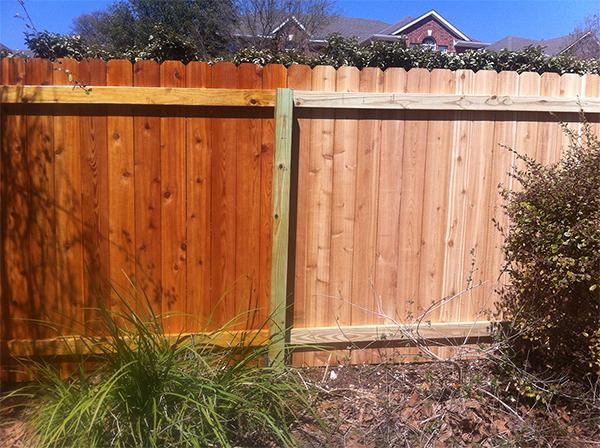
Oil-based penetrating stain outlasts water-based on fences and decks in Colorado. The reason is penetration depth — oil carries product deeper into the grain and leaves no surface film to blister. The bigger problem is film-forming stains, which fail faster than either and make future re-application significantly harder.
For fences and decks in Colorado, oil-based penetrating stain is the better long-term choice. It absorbs into the wood grain rather than sitting on the surface, which means it doesn't blister, doesn't peel, and fails gradually rather than all at once. Water-based formulations have improved, but they still don't penetrate as deeply — and depth is what matters in Colorado's high-UV, freeze-thaw climate.
What "penetrating" means and why it matters
A penetrating stain absorbs into the wood cells. There's no film sitting on top of the surface. When the stain wears out, the wood gradually loses colour and water-repellency — but it doesn't peel, because there's nothing sitting on top to detach. You clean, brighten, and recoat. That's it.
A film-forming product — whether it's called stain, coating, or deck finish — sits on the surface of the wood like paint. When that film fails, it blisters and peels. Getting it off requires stripping, which is a separate job with separate chemistry and considerably more labour.
How oil-based and water-based stains compare
Oil-based penetrating stains use a carrier oil — typically a modified linseed or tung-based formulation — to carry pigment and preservatives into the wood grain. The oil bonds to the wood fibre and cures below the surface. Water-based stains use water as the carrier, which evaporates faster, cleans up more easily, and produces fewer VOC emissions during application.
The practical trade-off is penetration depth. Oil carries product deeper into the grain. In Colorado's conditions — intense UV at altitude, low humidity, hard freeze-thaw cycles — that depth is what separates a fence stain that lasts 3–5 years from one that starts fading at two.
- Oil-based penetrating stain on a cedar fence: 3–5 years with proper prep
- Water-based penetrating stain on a cedar fence: typically 2–3 years in Colorado
- Film-forming coating on a deck or fence: 12–18 months before blistering begins on horizontal surfaces
Film-forming stains — what they are and how they fail
Film-forming coatings are sold in large quantities at home improvement stores under names that include phrases like "deck restore," "solid deck stain," or "deck coating." Film-forming coatings fail on horizontal deck surfaces within 12–18 months in Colorado. They trap moisture that comes through the boards from below, blister from UV heat above, and peel. Penetrating oil-based stain is the correct product for horizontal decks — it lasts 2–4 years and fails gracefully when it does wear out.
The same failure applies to fences, though it's less dramatic on vertical surfaces because water sheds off rather than sitting on the film. Solid stain on a fence will eventually crack and peel at the edges and grain lines. When it does, removing it is the only path forward before restaining.
Re-application: why your first product choice matters
This is where the difference between product types becomes most concrete. A fence or deck stained with penetrating oil-based product can be cleaned, brightened, and restained in a day. The new coat bonds into the existing grain without needing to remove what's already there.
A fence or deck coated with a film-forming product needs stripping before it can be properly restained. Stripping is labour-intensive and hard on the wood. Some homeowners apply penetrating stain over old film-forming product without stripping — the new product has nowhere to penetrate and bonds to the failing film instead. That job typically fails within one season.
Every time you choose a film-forming product, you're choosing more expensive future maintenance. We've worked on fences where a previous contractor applied solid stain, and restoring them to a penetrating finish is a significantly bigger job than maintaining one that was done right from the start.
What we use
We use penetrating oil-based stains formulated for Colorado's UV exposure and temperature swings. We don't apply film-forming coatings or solid stains on horizontal deck surfaces. If a customer asks for one, we explain why we won't and what we recommend instead. A stain job that fails in 18 months is not something we want our name on.
When not to hire us
If your fence or deck already has multiple layers of solid stain or film-forming coating on it, we can likely restore it — but stripping and prep comes before any staining. We'll identify what's on there during the estimate and tell you what it takes to get back to a proper penetrating finish. If you want us to apply a fresh coat over failing film-forming product without stripping, we won't. It won't last, and we'd rather not sell you a job that's going to fail.