Privacy fence, board on board, shadowbox, King Plus — each style looks different, costs different, and holds stain differently. Here's what separates them, plus a breakdown of Post Masters, no-dig posts, and why we mix concrete wet on every job.
Most homeowners pick a fence style based on what the neighbor has or what looks good at the lumber yard. There are more options than that, and the choice affects how the fence wears, how it looks from both sides, and how much stain and maintenance it needs over time. Here's what separates the common styles.
Standard Privacy Fence
The most common style in Northern Colorado. Dog-eared or flat-top boards run vertically, fastened to two or three horizontal rails on one face of the fence. From the street or neighbor's side, you see the posts and rails. From the yard side, you see the board faces. Simple, functional, and straightforward to build and stain. Most residential cedar privacy fencing across Boulder County and Longmont is this style.
Standard privacy fence has one visible side and one structural side. If appearance from both sides matters — along a shared property line, for instance — board on board or shadowbox are better choices.
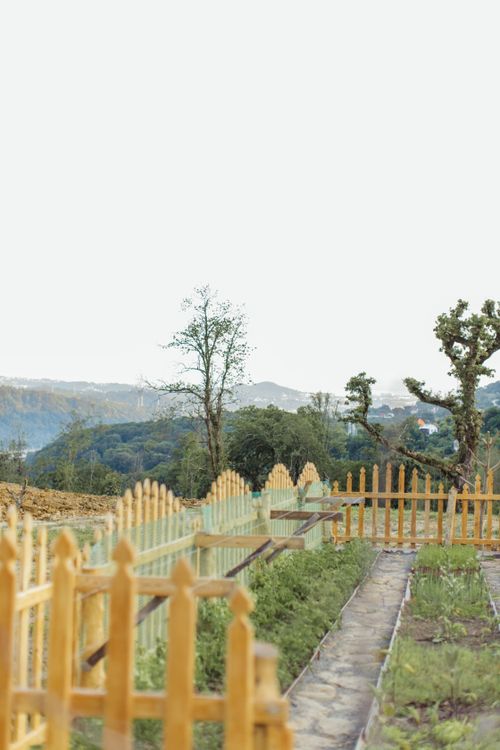
Privacy Fence with Post Caps and Trim
The same structure as standard privacy, with two additions: a cap on the top of each post, and a horizontal trim board (also called a face board or top rail cover) that runs along the top of the pickets. Both are upgrades worth understanding.
Post caps protect the end grain of the post — the most vulnerable point for moisture entry. Water wicks into end grain faster than any other surface, and that's where rot typically starts. A cap, whether cedar, vinyl, or metal, slows that significantly. The trim board gives the top of the fence a finished, intentional look and protects the top edges of the pickets. Both additions cost more upfront. The post cap protection, in particular, pays back over the life of the fence.
Board on Board
Boards run vertically with each board overlapping the previous one by 1 to 1.5 inches. The result is a fence that looks essentially the same from both sides — there's no structural back and finished front. It also has no visible gaps straight on, which makes it more effective as a true privacy screen than standard picket style.
Board on board uses more lumber than standard privacy fence because of the overlap, so it costs more per linear foot to build. It also takes more stain — more exposed surface area means more product and more time. For staining, board on board requires attention to the overlap edges where the boards meet, which can shadow and trap moisture if not covered properly.

Shadowbox (Semi-Privacy)
Boards alternate on the front and back rails — one board mounted to the front rail, the next mounted to the back rail, alternating down the length of the fence. Viewed straight on, the boards overlap enough that you see no gaps. Viewed at an angle, there are openings between the boards that allow airflow through the fence.
The airflow matters more than it sounds. Shadowbox fencing catches less wind load than a solid fence, which reduces stress on the posts and concrete footings — a real consideration in the open, windy areas of Weld County and east Longmont. It's also better for plants close to the fence line and for ventilation in tight side yards. Like board on board, it looks the same from both sides.
King Plus
King Plus uses wide boards — typically 6 inches — on the front face, with narrower boards behind them, creating a layered, shadow-line effect along the fence. The result is a more visually substantial fence than standard privacy or board on board, with a premium look that holds up well on larger properties or as a feature fence along the front of a home.
King Plus takes longer to stain than standard privacy because of the layered board profile and the shadow gaps between boards. Getting stain into those recesses matters — skipping them leaves unprotected end grain exposed to moisture. We take more time on King Plus staining than on flat-profile fences, and quote it accordingly.
Post Masters — the case for steel post cores
Post Masters are galvanized steel post sleeves set into concrete, with a wood post that slides over the steel and sits above grade on a bracket. The wood never touches the ground or the concrete directly. This is a meaningful difference from standard installation, where the wood post is set directly in concrete.
Most fence post failures start at the base — where the wood meets soil or concrete and moisture accumulates. Post Masters eliminate that contact point entirely. The steel core takes the structural load; the wood is the visual surface and sits in open air rather than in contact with wet concrete or soil. Post Masters add roughly $30–60 per post depending on size. They carry a 25-year manufacturer warranty on the steel core. A cedar post set directly in Colorado's clay-heavy soils realistically lasts 7–12 years before the base softens. The math over the life of a fence makes Post Masters worth serious consideration.

No Dig posts — when they work and when they don't
No Dig systems use driven or screw-in steel anchors instead of a poured concrete footing. The anchor goes into the ground — driven with a mallet or threaded in with a power driver — and the post attaches to the anchor above grade. The appeal is speed and simplicity. No mixing concrete, no waiting for cure.
The limitation is soil. No Dig anchors work reliably in sandy or well-draining soil where the anchor can seat cleanly to depth. They do not work well in Colorado's dense clay, caliche, or rocky soils — which cover most of the Front Range corridor. In those conditions, the anchor won't drive straight, won't reach proper depth, and the post will have less lateral stability than a concrete-set installation. If you're in a sandy area with good drainage, No Dig is a viable option. If you're on the clay-heavy soils that are typical across Boulder County, Larimer County, and most of Weld County, concrete-set posts are the correct approach.
Wet pour vs dry pour concrete
Dry pour means adding dry bagged concrete into the hole around the post, then pouring water on top and letting it absorb and cure in place. It's faster. It's how a lot of residential fence installs are done. It produces variable results — if the water distribution isn't even through the dry mix, or if the hole has drainage issues, you get inconsistent cure and weaker concrete at the post base.
Wet mix means pre-mixing the concrete to the correct water-to-mix ratio before it goes into the hole. More time to prepare, more control over the mix, more consistent cure. For fence posts specifically, that concrete is holding a vertical load against wind and lateral impact across the full length of the fence. The post base is not somewhere to cut corners. We mix wet on every job.